Contrary to popular wisdom, Google has a very nice business plan in place to monetize YouTube. By following a tweet from @cart, I got to the story below. The thing about a user network economy is similar to the wisdom of Hyman Roth in the Godfather. As in "Hyman Roth always made money for his partners."
Last week the world watched in wonder as Jill Peterson and Kevin Heinz's wedding party transformed a familiar and predictable tradition into something spontaneous and just flat-out fun. The video, set to R&B star Chris Brown's hypnotic dance jam "Forever," became an overnight sensation, accumulating more than 10 million views on YouTube in less than one week. But as with all great YouTube videos, there's more to this story than simple view counts.
At YouTube, we have sophisticated content management tools in place to help rights holders control their content on our site. The rights holders for "Forever" used these tools to claim and monetize the song, as well as to start running Click-to-Buy links over the video, giving viewers the opportunity to purchase the music track on Amazon and iTunes. As a result, the rights holders were able to capitalize on the massive wave of popularity generated by "JK Wedding Entrance Dance" — in the last week, searches for "Chris Brown Forever" on YouTube have skyrocketed, making it one of the most popular queries on the site: . . . So, what does all of this mean? Despite compelling data and studies around consumer purchasing habits, many still question the promotional and bottom-line business value sites like YouTube provide artists. But in the last week, over a year after its release, Chris Brown's "Forever" has again rocketed up the charts, reaching as high as #4 on the iTunes singles chart and #3 on Amazon's best selling MP3 list. We've seen similar successes in the past with partners like Monty Python.
Free advice: Get this to market faster rather than slower. NOW would be good. The day this is in the field, I'll add 500 shares of XRX to my IRA. It should blow out the MPS space.
In other news-to-me, it turns out that Xerox already has a channel on Youtube. Go to YouTube. Search on Xerox. As of today there are 32 videos posted. More Free advice: Suggest to the Education - facing sales force in MPS and MFP, that they send out emails in the following form,
Subject line: Have time for a chat about how this could work for your school?
Subject line: Take a look at the iGen4, it really does the change the game. Body copy: No videos as of today. This still needs some video for printer, not corporate.
If someone can get the comp right, MPS and MFP could join together with the commercial Print salesforce to sell MPS and/or MFP and/or Commercial Print. Then all of the commercial print sales force could send out the appropriate to emails to everyone in their suspect/prospect/customer/client/fan bins and start lots of interesting conversations.
The really disruptive innovation would be to get all of them to connect with Newspaper Ad people. When that's in place, small business will have access to multi-channel marketing programs that are easy to buy, demonstrably effective. It will bring millions of new customers into the market.
As you may know, I really like WTT.com. They make my kibbutzing from the sidelines so much easier. I wait for the morning email, it's usually there by 5:00 am EST. I pick my way through the latest and the greatest, then have an easy time bloviating. Monday's is usually the best because I can reasonably expect Dr Joe to do some heavy lifting that gives me an easy peasy blog post. This Monday morning's post.
This morning, I got an email that took me to a link for a video on Erasable Paper, an interview with Maggie Ochs. You also might know I think erasable paper is a game changer for Xerox MPS. I took the click. I heard "Hi, this is Gail Nickel-Kailing, and I'm here with Maggie Ochs . . . and then it froze the browser. Every time I try to view a video at WTT, it does the same thing. It's probably me, but I'm much too cranky to care if it's me. Then I have to force quit. Then I have to reopen the browser. Then it happens again.
My humble suggestion to my dear colleagues. Put the video on YouTube instead of whatever you're using. Set up a WTT channel over there. Embed the video on WTT.com. Put ads against the video at YouTube. I never, never had a YouTube video lock my browser.
Even better, how about a transcript in addition to or instead of the video? I hate spending the time watching a video when I can get the information in print so much faster. Meanwhile, I'll try again in a little while, when I have the time to see if waiting for it to load will make a difference.
Now on YouTube - Local News - NYTimes.com "YouTube, which already boasts of being “the biggest news platform in the world,” has created a News Near You feature that senses a user’s location and serves up a list of relevant videos. In time, it could essentially engineer a local newscast on the fly. It is already distributing hometown video from dozens of sources, and it wants to add thousands more.
YouTube says it is helping TV stations and its other partners by creating a new — but so far not fiscally significant — source of revenue.
But news media companies may have reasons to be wary. Few TV stations have figured out how replicate profits on the Internet. YouTube can easily act as another competitor."
The reason that newspapers have figured out how to replicate profits on the Internet is that it's not going to happen. Real estate on the internet is limitless, so the price of real estate goes down. Real estate on paper is limited. That's why local advertisers will pay for ads in Print. Clickable print means everyone can get customer informatics. All good for Print.
Consider clickable print as a Table of Contents for Personal TV.
Did anyone else notice that President Obama used YouTube to address the nation on the economic plan? Or that the Republicans posted their response on YouTube? Obama's video got 800,000 hits as of 9:15 am on Monday. Consider what 800,000 viewers would cost through a regular media buy. Consider what a neat metric how many people choose to view a video.
What a nice way to get the information PR needs without paying a cent.
If it's managed correctly, I bet that we can find some of our "excessed" employees to manage this thing from their homes. With a base comp and an upside based on results measured by number of hits.
So...suppose we did this:
1. Find the 5 most creative people at our agency. 2. Get them to do some very cool 2 minute videos about Xerox, Xeroids, PARC, Dubai, Rochester, MFPs, Igens, etc.etc. 3. Create the Xerox channel at YouTube. 4. Then use the deep connections we've made to creatives to get them to do the same thing. 5. Have a contest for college student designers for videos that tell the story that:
Yesterday, Xerox = Copy. Today, Xerox = Print and Scan. Anywhere. as in . . . Google it. Find it. Xerox it. Anywhere.
6. And have everyone upload videos to the Xerox Channel on You Tube.
When PC to TV screen finally gets settled, we'll be ready with a massive library of videos. If they are cool enough, people will watch them for fun. And people will start to understand how really cool we are.
Meanwhile stop trying to fight our greatest brand advantage. Forget about the "registered", "copyright", "do not use this name under penalty of blablabla".
It could save us some money and wasted focus for our lawyers. Plus we could probably pay the 5 most creative ad agency folks a fraction of what the Agency costs. It might be a way to get our SG&A down to 16+%, without having to lose so many valuable people.
Plus in the era of Obama, imagine the free press coverage we would get. PR anyone?
Dumenco's Media People: More From Benjamin Wayne on YouTube - Advertising Age - The Media Guy: "'Believers,' Mr. Wade wrote, 'would have us think that Google will sustain YouTube, indefinitely if necessary. Proponents of online advertising argue that increased understanding of the medium will lead to more advertising dollars at better CPMs, lifting all boats in a sea of monetization.' Wayne offered a contrary take: 'YouTube is soaring towards the future like a pigeon towards a plate-glass window.'"
Or
Google thinks clickable postcards connected by mobile phones to Youtube videos is a neat way for small business to get more customers. The analytics + a logo on the video should do the trick.
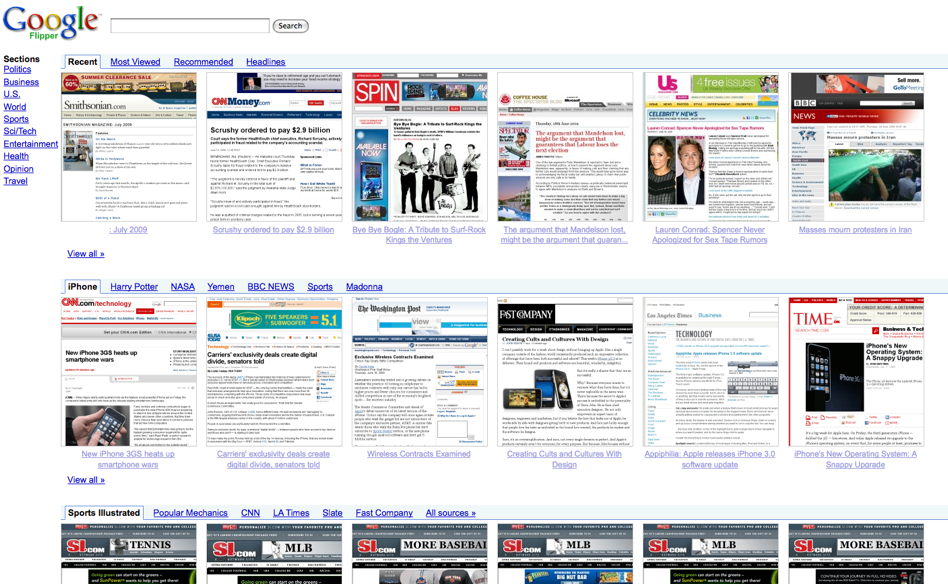
All that money and effort to get the experience of "flip through it" see snippet From this printer's point of view, it's pretty funny.
Meanwhile the wikipedia-entry-appearing-with-search is the killer app if and only if you connect to the printernet. Consider: A versioned newspaper with 3 pages of the lede + 2 paragraphs with the wikipedia entry and link to the YouTube video. The other 21 pages are filled with whatever and lots and lots of print ads.
If the community of interest is a high school class and the content contains news stories chosen on the basis of what a classroom teacher needs textbooks in California can disappear in peace. And the high school ed problem for every one becomes much more manageable. If you add in public health and service advertisements the whole thing makes money for everyone. Just ask your ed and non profit users and see what they say.
If the community of interest is a organization you can sell ad sense users a platform in print ads that speak directly to the needs of that organization. If it's a bunch of hobbyists, same thing.
Geeks just can't see Print As a Print person, I've seen this with designers, admins, and especially with geeks. They keep just drinking their own Kool-Aid.
Ok, newspapers haven't had the speed or the scale, but with printernet publishing that goes away. 50,000,000 versioned newspapers with content pulled from the cloud from search, edited for a specific community of interest and delivered overnight with a minimal carbon footprint. Plus ads to make some money in the bargain.
C'mon Google, the web is all very nice, but if you want to crack the real world and the mobile web get in touch with a Print Professional. Ask him/her about Clickable Print.
Printers print stuff. Publishers use printers to print stuff. Most publishers don't care about what Print can do. They're all caught up with blablabla business models blablabla advertising blablabla ROI blablabla meme du jour. Meanwhile Printers keep printing more and more stuff.
So cut out the middle man, let everyone be a publisher in print. If you think blogger is a big deal, consider what happens if you use Clickable Print to be the real world portal to Blogger +YouTube + Wikipedia + Facebook + whatever comes next.
The two mass media are TV and Print. Everything else is a niche media. You already have a nice lead in TV with YouTube. Once you can figure out the Print piece, you can stop having to mollify a bunch of "content creators" who think their words should be locked behind IP.
I'll let the engineers reinvent the newspaper on the web. Nice for the niche web audience. And then the niche of a niche that reads on the web. Then let the MBAs figure out the "new business model." Sooner or later they'll figure out something.
In the meantime, I'll stick with paper, thank you very much.
From Tech Crunch Google Flipper Is About To Jump Out Of The Water: "Google is about to launch a new Google Labs project it calls Flipper, we’ve learned. No, it’s not a dolphin. As you can see in the screenshot, it looks like the project is a more visual way to read Google News, or to “flip through it,” as it were.
MediaPost Publications Four Ways To Plan Around The 2009 Internet Video Backlash 07/22/2009: by Ben Weinberger, "By all measures, 2008 capped a banner period of growth for Internet video. In the span of a few short years, consumers have done what all the experts said was impossible: radically alter their video-watching behaviors, frequently trading in the 'couch potato' experience of watching TV on the sofa to view snippets on the mobile phone or catch a missed show on the computer after the initial broadcast.
As the economy rebounds, there are four ways everyone in the industry can help contribute to the ongoing economic growth of online video advertising:
My thoughts regarding Ben's suggestions follow:
1. Encourage new advertising models and expanded inventory for alternative platforms now, while consumers continue to modify their TV-watching behavior.
An under appreciated value of video commercials is that they are often the content that people want. An agency or a marketing officer could by step the cost of media placement completely. Once videos are posted at YouTube basic metrics are collected free of charge. I assume it would be possible to make a deal with Google to get drill downs to create a data stream that could be quite useful. The business model is to make money by eliminating the cost of media buys or to use the stick of a youtube only strategy to negotiate lower prices.
2. Take advance of the digital format by repurposing content across multiple platforms, enabling advertisers to follow suit in complementary ways.
Videos can be divided to take advantage of different lengths appropriate to different media. It might work out that a 15 second spot is correct for the smart phone, a 30 sec to 2 minute spot is best for YouTube, a 2 minute spot is correct for viewing on a living room internet connected flat screen. The creative and production costs could be amortized over the various products to go to different audiences.
3. Know your data -- and your target audience -- inside and out.
This is the must have. The new deliverable is actionable information to inform marketing decisions going forward. The issue is to know what works and what doesn't in real time so that adjustments can be made and new interventions made. The days of focus groups and blind studies are being replaced with try what you think will work, revise and do it again.
The issue going forward is to have teams of creatives that can respond fast enough to execute.
4. Encourage patience among peers, clients and business partner
Sorry, I think this one is a non starter out of the gate.
The new role for Print and Printernet Publishing. The last ten years of advances in digital printing have resulted in a new ability based on massive parallel manufacturing. The most recent example is the work that National Geographic contracted to HP. National Geographic announced yesterday that they are doing a Special Edition where users can add their picture on the cover of a printed issue of the magazine.
While the results are not yet in, the point is that the actual production is being done on a "fleet of Indigo 7000's that are managed at the Consolidated Graphics multi locations. My understanding is that they have 70 locations around the States and some throughout the world.
Printernet publishing is meant to capture this new reality on the ground.
Clickable Print Clickable print points to the new reality of printing information rich 2d codes on paper for mass distribution. The codes can be in many forms. What's new is there is at least one format that can be produced at scale. So far the only one that has gotten on my radar is CodeZ QR produced by CODI. The point is that the data stream that can be harvested is very rich. Connected to the appropriate analytic engines, new insights are possible about consumer's behavior.
In the form of a TinyUrl they are the human readable URL which should make it simple to type in the browser. A tiny Url while 25 characters in length have only six characters that change. Six characters can be easily remembered to type into a browser.
In the form of an information rich QR code, the user can "click" on the paper and with no further actions be taken to a video on their smart phone.
Found this at Patrick Henry's new blog at The Printing Office. hosted at PrintCEO. I've been on this little soapbox for about a month , so it was great to find Patrick's post. I'm still hoping for the Dr Joe Webb/Frank Romano show on YouTube. I'm seeing "Siskel and Ebert" for Print.
Printers of all sizes are making creative use of YouTube for marketing, customer relations, and just plain fun. Warren Werbit’s rant-heard-round-the-world is a viral classic. But others are making their presence known in their own ways, and the results can be a treat to watch.
Kevin Keane, president and CEO of IAPHC, sent us links to videos posted by his members. This one, from Brodock Press of Utica, NY, captures the entire print manufacturing workflow in a little over two minutes:
Back on January 26, I did some blabla about the Xerox YouTube channel. At the time I said,
Find the 5 most creative people at our agency. Get them to do some very cool 2 minute videos about Xerox, Xeroids, PARC, Dubai, Rochester, MFPs, Igens, etc.etc.
On May 20th, you posted a cool video. As of this morning, it got 40,793 views. Given that there are no new ideas, I assume this has been kicking around the agency for months before January 26. My best guess is that finally someone got someone in Stamford or Rochester to lighten up.
Just in case Clickable Postcards are not yet on your radar . . . It's drop dead easy. Front of this card is
The very information meant to inform us is actually making us STUPID! It's affecting millions of business people. Is IOS affecting you?"
Back of the card is a tinyUrl + a QR code and a tag line with the local printers web site address. Marketing material for the printer + building the brand for corporate.
They'll produce a couple of million postcards, get them distributed all over the country in a couple of days. If you give them the list of premier Partners, they'll do the personalization and drop ship.
Of course it would be a lot cheaper and easier to printernet publish (distribute and print.) But while they sort that out, Clickable Print New York could get the postcards on the street the day after you post the video at YouTube.
I can't see how a couple of million postcards doesn't get 40,793 views to at least a couple of hundreds of thousand. With the videos I know you can do, I can't see any reason why you couldn't get up to a couple of million. If you put up some of the awesome 30 second spots you've done over the years, it should be easy.
I don't know enough to know what's behind "location and communication intelligence offerings." But no doubt in my mind that's a good thing to do.
The part that really caught my eye was "complimentary webcast." Webcasts are much better than webinars.
Here's the but... part. Unfortunately the webcast is not on YouTube. That means I had to wait for it load. While it was loading, I did a search on Pitney Bowes at YouTube. It didn't come up. I'll have to catch it some other time, if I remember.
Pitney Bowes Business Insight, the leading global provider of location and communication intelligence offerings, today announced the availability of a complimentary Webcast, featuring Toby Bell, Research VP at Gartner and Lisa Sutrick, director of CCM product management at Pitney Bowes Business Insight. Available now on-demand, the “Transform Your Multi-Channel Customer Experience: Advantages of Customer Communications Management” Webcast discusses how organizations can leverage personalized communications to improve customer relationships
Here's the link to Google Tech Talks Channel on You Tube. Check it out to see what I mean about the content of graduate education. The YouTube part makes if free and personal TV. View on the mobile, in the living room or on the computer. The Clickable Newspapers are reinvented textbooks.
Tests are to be able to sell certificates. Selling certs is the high margin business.
The Clickable Newspaper (reinvented textbook) piece:
One possible version of the words
This year, a new transportation bill will be working its way through Congress, and now is the time to talk about bold new ideas for a 21st century transportation system. The Transportation for America Campaign, a national coalition to drastically reform the transportation bill, is bringing people together across the country to hear about the projects and visions for change that people have. How we will move people and goods more cheaply and protect our environment? What do we need in a national transportation system to compete in the global market? What do we need to get from our homes to our jobs or to school? How do we build a transportation system that helps us reach our climate change goals?
Join the Google Town Hall Meeting on Transportation to learn about the Transportation for America Campaign, talk about critical transportation needs for the region, and discuss how we can get there. Congress is talking about $500 billion for transportation - what do you want to spend it on?
"Why are they going around now after the bill is passed. To think that they just appropriated that amount of cash without prior planning of what was needed and where it should be spent just makes me want to drop a bomb on congress."
"The way she talks about jobs is so typical of a government employee. "We need to create as many jobs as possible". No you don't! You need to ensure efficient and cost effective transportation. Part of that is only creating as many jobs as necessary. . . . I guess if you have $500 Billion to throw around you could just give everybody a shovels to maintain the roads and get full employment in a jiffy."
"Google CEO Eric Schmidt is on the board of directors of "New America Foundation". They talk alot about the "new" NAU rail system coming. People have no clue."
"I am a threat to the industry. I am a threat to workers in white-collar. I am a threat to the old. I make history. I Make Industry. I make Innovation"
Publish in a Clickable Newspaper for High School Kids. Compare and Contrast. Repeat as needed.
About 3 weeks after starting Tough Love, I got on my little soapbox about YouTube channels. Since then I've been singing the same song.
To be clear my focus is on fixing High School education at the bottom of the pyramid. The functionality of YouTube channels for learning can be repurposed to fit specific circumstances at very low costs.
As I wandered around Twitter yesterday, I followed some links to find KodakTube. I have to say, in my humble opinion, they've got it just right. You can follow the links at the tweets below to see if you agree.
In 4:05 mins at KodakTube, Noel Ward+Nick Benkovich showed me Prinergery. http://bit.ly/3DD3V Prinergy=secret sauce. Full Disc: Long EK
Awesome(2me) vid at Kodaktube. "It's time to smile." http://bit.ly/iCJwb {Focus on smile+smart not ROI. ROI will come naturally. #Print09
CHICAGO (AdAge.com) -- Only 24 hours ago Domino's was looking for a reasoned response to a web video showing two employees apparently defacing its food. The pizza chain had located the employees and was examining its legal options but was trying to stay below the radar.
Consider how many disgruntled employees are being laid off and have lost their pensions, instead of being retrained or nurtured to move to new careers. Then consider how easy it is to make a video. Then consider what it must be looking like at the Domino PR firm today. As our politicians are learning every day, it does not pay to spin or to do the wrong thing.
Free advice to PR people Tell the truth to your clients. If you don't sooner or later, you are going to take the hit. I know that it's really hard to tell truth to power. But that's your real job.
When your client makes a stupid decision, tell them as quickly as possible. As soon as you find out about the latest stupid decision, get someone to make a smart decision, fast. The reported $12,000,000 + $125,000 comes to mind as the stupidest thing I've heard about this week. Especially with May 29th very close. Do you really think this is not going to get on the radar of the 4 institutional investors who have almost 30% of the common?
If you don't know, say "We don't know." Don't predict profits if you don't know. Don't announce products without announcing the dates and time to market. Erasable paper? Stream?
Stop trying to play defense. Stop wasting time trying to get some distracted too busy to think journalist to get the story right. The whole thing is moving much, much too fast for defense. The time/space for PR is internet time, not corporate time. The power player is not the media. The power player is the internet and every person with a video camera who touches the company.
Morph into message managers. Consider using the printernet to manage the message. With all the OPMs (PSP) you have, you could do a million hits over night, in Print, and create revenue for your installed customer base at the same time.
So the value of a box is not just a box. It's being part of network that supplies work.
In less than a month since being posted on July 19, 2009, the user-generated video had nearly 20 million views, or about 830,000 per day. In less than a week it had more than 10 million hits. And the “JK Wedding Entrance Dance” video continues to show strong viral growth. It is also likely generating revenue and profits for Google given related advertising and music purchase links, according to Citigroup analyst Mark Mahaney."
As of this morning, the Anywhere, Anytime TV below earned over 20,000,000 viewers. The production cost and the distribution cost was zero. It's impossible to calculate the ROI, given that the denominator is zero.
Note that the story is authentic. Note also that it's about love and joy. The evidence says that means that effective communication with the best ROI needs to be authentic and if possible it should be about love and joy. Our agencies are great at manufactured love and joy. It's the authentic part that is so hard to do.
That's why the Christian Science Monitor needs clickable print published on the printernet.
The best short form TV is the great 30 second spots. YouTube is TV anytime. The Smart Phone is personal TV. Google already built the infrastructure. Apple hasn't yet come out with iTV and Amazon is all about the books and buying stuff.
So, start cutting out the middleman. Why pay a gezillion dollars to buy eyeballs? You can spend a million dollars on the ads. Then a 1/4 million to gather the fans by paying close attention to the hits and whether you get a twitter buzz. Then another million outsourcing the data analytics to Google. 2.25 million is a lot less than a gezillion.
If you use information rich QR you can get back to using Print Then you can give the CMO even better data than they get from the web. If Google builds the tools to analyze the QR derived data, the game is up. And you can concentrate on producing even more awesome videos.
Once you stop doing all the stuff you don't need to do, you can look at reinventing textbooks with clickable newspapers and tell some really important stories, 30 seconds or 140 characters at a time.
The last mile is PC to TV. What do you think? My bet is 3rd quarter and then mainstream. Meanwhile, the great "How is Google going to monetize YouTube" question looks like "become a TV network and sell advertising." That seems like a good business model.
If we could sell toner and paper with their cost of sales, it would be a lot easier for me to get a good dividend while we all wait for the "Market" to come back to the real world.
At any rate, how about we do the Xerox YouTube channel and be ahead of the curve? Maybe we could use the channel to sell E-Paper directly from the web. No channels. Very quick. It's a nice way to scale before someone else does. Plus it would probably help drive SG&A down to the WalMart metric of 16+%. Maybe we could hire some recently excessed to manage it or produce the ads. Comp them based on clicks.
Or maybe some of our recently excessed could do it themselves. Or maybe some of the great creatives in our network could do it. Then sell it to us for a gezillion dollars.
read at MediaPost "The NBC/News Corp. Hulu video site will get one of the biggest marketing platforms ever for the Internet video site: this Sunday's Super Bowl to add on NBC.
The company issued a press release announcing the media buy.
Analysts note that the Super Bowl has had a price tag of $3 million for a 30-second spot, although the price tag has dropped in recent days, according to reports."
I assume the folks at IBM and HP have this on their radar. It's the reason that the margins on organizing busyness will be under enormous pressure. It's always hard to compete against free.
But the good news is that Print can ride this wave.
BTW, the Google development team is based in Sydney and as of this morning, the video on YouTube got 2,480,764 views.
As promised here's the postcard. Feel free to use it if you think it would help.
1. We are world experts in document management. 2. Our distributed in place network of Igens would allow us to distribute and print, faster, better and cheaper than anoyone else. 3. Our manufacturing partners would have useful timely information in Print to use as promotional material to stay top of mind of their customers at very little expense. 4. It would probably increase the need for toner, supplies and post sale service.
While following how the "news" communication ecology deals with reporting on us, it's become clear that it's a broken system. If they can't get our story straight, how can we reasonably expect that they will be able to communicate the much more complex ever changing story of economic redevelopment in America.
Here's what I mean.
The Fitch Ratings Press Release showed up in my RSS feed at 4:32 today. It took me less than a minute to scan the online document. Then about 30 seconds to find the parts I thought were the crux of the issue. Then another 30 seconds to cut and paste. Then about 5 or 10 minutes to think about what I chose. Then another 10 seconds to post here.
That's the real power of documents. Prepared correctly, a document is the best Search platform ever invented. If the document presents in Print, it's a mass audience. If the document presents on the web, it's a niche audience.
Another function of a document is to enable compare and contrast. You can compare and contrast my view of the world with your view of the world by scanning and searching the full PR release here. And then the AP translation of that document here.
Note how much easier this would be in Print. "Compare and contrast" is how you practice thinking. The rest is skills and character training. That's why readers have to print things out. That's why erasable paper is a game changer. It will enable thinking. That's why when textbooks are reinvented it will be a combination of Print and Kindles.
Anyway, here's what I think is most useful in the Fitch press release.
Ratings strength include: --Significant recurring post-sale revenue from vast and growing base of installed machines;
--Stable cash generating capability;
--Xerox's strong brand name and product portfolio; and
--Solid liquidity and credit metrics, especially core metrics.
Fitch's rating concerns consist of: --The impact of the global weak macroeconomic environment on sales and profitability, especially on equipment sales;
--Increasing write-offs in the financing receivables portfolio due to rising customer bankruptcies;
--Intense competition resulting in consistent equipment pricing pressure, especially in the office segment; and
--Limited organic revenue growth.
A positive rating action could result if --Growth in post sale revenue and profitability more than offsets a decline in equipment sales, allowing for total revenue growth in 2009.
--There is a material improvement in credit metrics, via debt reduction or operating profit improvement.
A negative rating action could result if: --Significant further acceleration in sales and/or profitability declines occurs, especially in post-sale, driven by reduced demand amid the current global economic downturn. Ongoing material declines in post-sale revenue would indicate that the revenue stream is more susceptible to economic factors than previously anticipated.
--Significant deterioration in the quality of the company's financing portfolio resulting in further write-offs and lower FCF.
--Free cash flow trends below Fitch's expectation, due to profitability declines and/or working capital uses, which would weaken the company's liquidity position relative to its ratings.
--A significant debt-financed acquisition outside of current expectations or resumption of share repurchases during the economic downturn.
At 5:32 PM, incoming RSS presented the Forbes posting of the AP story. The AP translated the document and slapped a copyright on the rewrite. As in:
Copyright 2008 Associated Press. All rights reserved. This material may not be published broadcast, rewritten, or redistributed
There are two kinds of news.
One is seeing what is happening in the real world. Then crafting a story about it. The other, our sweet spot, is translating documents to craft the story we want to tell our viewers. I say viewers instead of readers because very few people have the time to read. If you want the longer story on that, I did a post on my other blog. You can find it here.
Public Relations used to be about managing the public discourse or the "news cycle." We all saw how well that worked in the last election cycle. Today, most of what passes for news is rebroadcasting PR releases. Now, that's falling apart. People don't trust the news because they have learned that most of it is recycling "news product" to attract eyeballs. But our problem is NOT to attract eyeballs. Our problem is to get the facts out to investors and customers.
So, until the news industry stops worrying about how the sky is falling, we have an opportunity. With our CEO sitting next to the President we have the best source on the planet for what the economic advisors are thinking. Given the drive for transparency, it should be public information. Because the real problem of America is to get people much smarter, much faster we can do well, by doing good.
Meanwhile, Fitch says they are concerned with questions of organic growth. Fair enough. Our global network of standards based iGen owners is one source of organic growth.. It's not the tech. Sooner or later everyone gets the tech. Now with IBM+Ricoh and Screen entering the long run transpromo in the States (I prefer to call it TransInfo) that's getting pretty crowded.
Our advantage is the deep relationships we have with the people who run the iGens on the ground. The boxes, the common concerns about growing business, the common Xerox standards and languages and maybe the most important, trusted personal relationships, have created the foundations of a huge reserve of global social capital. While the box business is settling down, we can monetize our advantage in social capital with a single minded focus on "distribute and Print".
Back to the news opportunity. To the extent that "news" organization translate documents, we can do it better. To the extent that niche publications in Print delivered to decision makers and opinion leaders has real value, we can do it better. To the extent that our country needs much smarter opinion leaders to guide the public discourse, we can make a significant difference.
The steps: 1.Gather public documents - Congressional hearing transcripts, State and regulatory transcripts, Bills in Progress, Bills Passed etc.
2. Task our PR firm with crafting stories for different niche audiences. Our audience in Dubai or London is not worried about the same things as our audience on Wall Street or Cleveland.
3. Create multiple press ready PDFs. The flat size is 14 by 20. As far as I know, we do the best 14 x 20 on the planet.
4. Move the PDF's through the Cloud to our iGen output network.
5. Get buy in from our partners. First, giving them a timely interesting publication that they can send regularly to prospects and customers.
Second, by showing them how to sell local ads in their locally produced newsletters. They will have an easy path to find new prospects, talk to existing customers and demonstrate the power of timely information about important issues.
The societal benefit is that the Xerox network is well positioned to have a significant effect on making people smarter, faster. Do well, by doing good.
Xerox used to mean Copy. Today, Xerox means Print. Anywhere.
Google it. Find it. Xerox it. Anywhere.
Revision after original post: I just did a post at my other blog, Print In the Communication Ecology, talking about the same thing to a different audience. Added at 9:27 Eastern Time. This is not as hard as it seems. Back in the day at Parsons, in the Pub Center I set up, two professionals + one very good student, organized an international exhibition of 14 x 20 posters in Belgrade in three weeks with art supplied for free from about 30 great designers from all over the globe. The money invested was about $200. It took about 3 weeks from idea to exhibition and got 35 minutes of local television time. You can watch the video on YouTube. Here's the video- stored at YouTube.
Xerox News Network? Xerox TV? It has a pretty good ROI.
Printernet publishing would allow message makers to speak directly to their audiences without the intervention of the media. There is no technical reason to stop a PDF file or a data stream being distributed to a network of PSPs and produce millions of copies distributed around the globe or 3000 copies for a neighborhood, with a minimal carbon footprint.
It might first appear that this is a solution looking for a problem. But it's becoming clear that the problem of mainstream media is adjusting to a world where grown ups are in charge and the nature of journalism is moving away from "gotcha." It is inexorably moving towards finding the stories that inspire and what Malcolm Gladwell describes as solving mysteries instead of puzzles.
As the mainstream media adjusts, it opens space for a printernet to grow.
a reshaping of credibility from objectivity to transparency, would have profound implications for every organization – corporate, non-profit and governmental – in our society.
And then today there appeared an article at Miller McCune Magazine. It reports an experiment that finds citizens prefer political news un-mediated by journalists and vice versa.
Most political leaders would generally like to get out their messages without a media that often adds its own twist to the story. And more and more, they actually are trying to do so: Some are putting up their own videos on YouTube.com; others are now sending out their own Twitter feeds.
Imagine if politicians had the ability to printernet publish. They could get a 4 page newsletter, versioned for every important niche audience in their constituency delivered in a day or so from the time they hit the print button.
That's just of the many problems, the printernet would solve.
Miller-McCune Online Magazine: "According to a new study, one consequence might be that citizens would feel better about the political process. They'd be less cynical; they'd think politics was more representative. At least, that's what Brian J. Fogarty, a professor of political science at the University of Missouri, St. Louis, and Jennifer Wolak, a professor of political science at the University of Colorado, Boulder found. Their study is published in the January issue of American Politics Research."
To assess how people might respond to political information when they read it as news as opposed to when they get it directly from politicians, they had one group read a news article and one group read dueling editorials from prominent political leaders on one of three issues — affirmative action, drilling in the Arctic National Wildlife Refuge (ANWR), and stem cell research. In each test, the article and the editorials contained the same information and perspectives.
The two groups were then asked to respond. "Do you feel that the views presented in the article reflect the opinion of ordinary Americans?" Of those who got the news directly from politicians, roughly 45 percent said yes, the views were representative of ordinary Americans. Of those who read the news articles, meanwhile, only 16 percent found the views representative. (The results were generally consistent across the three issues). That adds up to a pretty sizeable difference, given that both groups were presented with the same information.




 Posts

